
- Circle the words that begin with a bilabial consonant: met, bet, pet
- Circle the words that begin with a velar consonant: got, cot
- Circle the words that begin with a labiodental consonant: fat, vat
- Circle the words that begin with an alveolar consonant: zip, nip, sip, tip, dip
- Circle the words that begin with a dental consonant: thigh, thy
- Circle the words that begin with a palato-alveolar consonant: shy
- Circle the words that end with a fricative: race, wreath, bush, breathe
- Circle the words that end with a nasal: rain, rang, dumb
- Circle the words that end with a stop: lip, lit, crab, dog, hide, back
- Circle the words that begin with a lateral: lull
- Circle the words that begin with an approximant: we, you, one, run
- Circle the words that end with an affricate: much, edge
- Circle the words in which the consonant in the middle voiced: mother, robber, leisure, stomach, razor
Category: Uncategorized
/r/ and /l/: Place and Manner of articulation
Place and manner of articulation:
In the International Phonetic Alphabet, both retroflex and lateral sounds are classified under “approximants” (a manner of articulation), they are defined as (most cases) occurring in the alveolar ridge (**the retroflex may occur in the hard palate, see here) (place of articulation). The lateral consonant may be produced in other regions of your mouth as well, see here (and see below), but for our purposes we will classify it as a consonant occurring in the alveolar ridge.

How are they produced?
In the production of these sounds the tongue produces partial closure in the mouth, but air is escaping. The air quality is not turbulent, so these sounds are not fricatives. They “approximate” at a closure, air is escaping, and they both have vowel-like qualities to them.
Together /r/ and /l/ sounds are also called liquids sounds because of their resonance and vowel-like quality.
fənɛtɪks wi:k θri: “SKINFLINT” Ladefoged exercise [Answers]
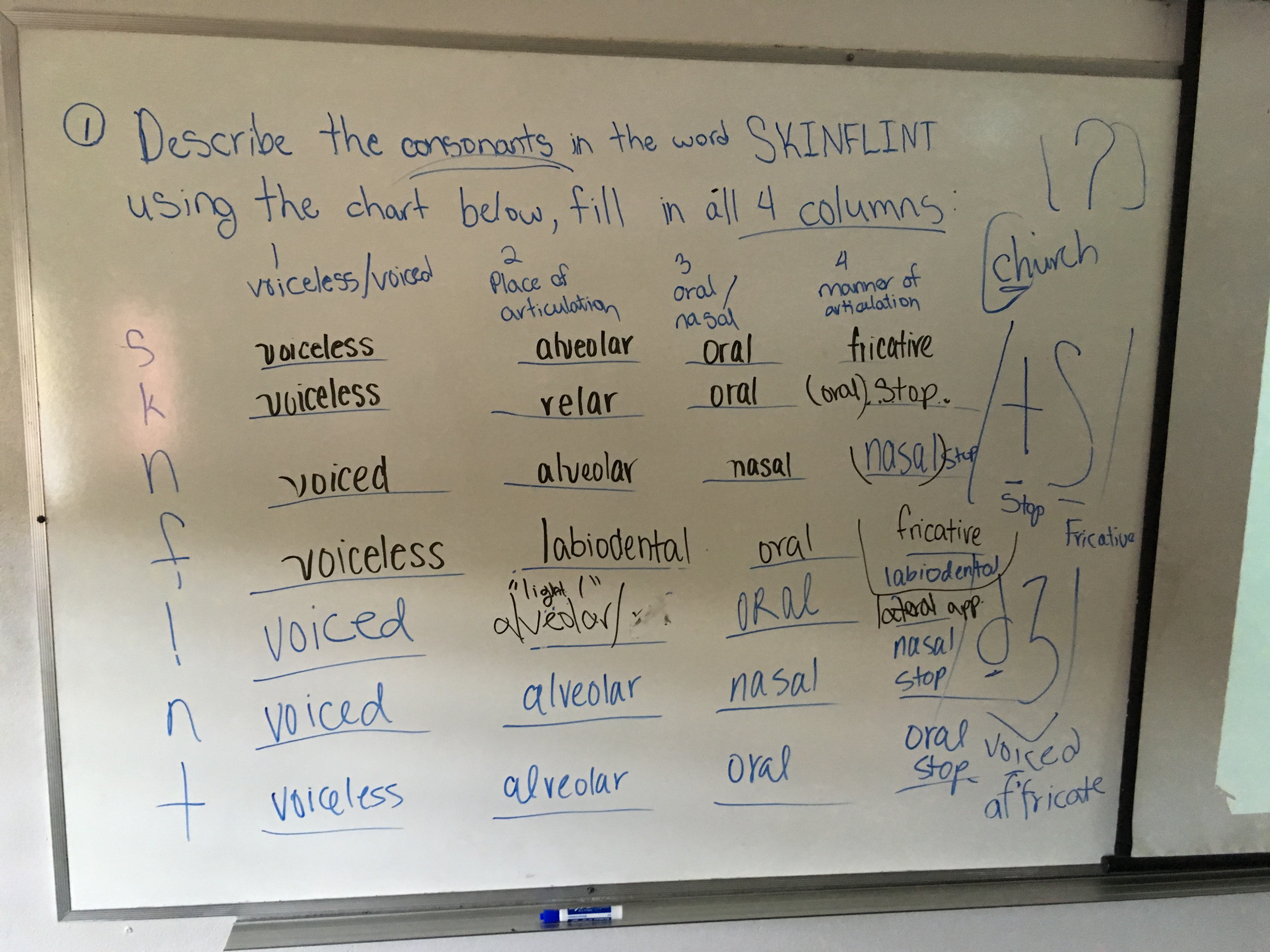
fənɛtɪks wi:k θri: (Week 3)
We spoke of the other manners (gestures of articulation):
- trill
- glottal stop
Below I have included videos that illustrate the way the articulators come together in the shaping of these sounds.
Trill
Glottal stop
fənɛtɪks wi:k tu: (Week 2)
Hi everyone!
Here’s a refresher meant to help you all. This week we’ve discussed the different mechanisms behind speech production and voiced and voiceless sounds. You will be tested on your ability to list and describe the speech mechanisms, as well as what makes a sound voiced and/or voiceless.
FOUR SPEECH MECHANISMS
(1) airstream process: consists of all the ways of pushing out air (and sucking it in); respiratory system produces air, lungs pushes out air to pass by the windpipe (trachea).
(2) phonation process: airstream reaches the LARYNX where it comes across the vocal folds (vocal folds are at the top of the trachea). There are two possible outcomes in the phonation process: voiced or voiceless sounds.
(3) oro-nasal process: airstream reaches the pharynx, the oro-nasal process decides whether the air goes out through the MOUTH or through the NASAL CAVITY/NOSE. Air goes out through the mouth when there is a VELIC CLOSURE. Velic closure happens when the soft-palate is pressed against the BACK WALL of the pharynx.
(4) articulatory process: when air reaches the vocal tract. Two of the most important articulators in this process: TONGUE and MOUTH, particularly how they interact with the roof of the mouth and the pharynx.
VOICING
TIP: You can check whether a sound is voiced/voiceless by touching your neck, where your Adam’s apple would be (for men), which is approximately where your larynx is located.
Voiced sounds happen when the vocal folds are closed together, such that there is a narrow passage for air to travel through. Because of this, air build ups causes the vocal folds to move up and down producing a vibrating quality in the airstream and fluctuations in air pressure (e.g. zzzzzz, vvvvvvvv)
Voiceless sounds happen when vocal folds are open, air is traveling freely through your larynx , sound quality is then quieter, and does not cause a vibrating quality (e.g. sssssss, fffffffffff )
THURSDAY/FRIDAY MATERIAL
In today’s class we discussed PLACE OF ARTICULATION (this is part of the fourth mechanism for sound production)
Consonantal sounds are described in terms of their PLACE and MANNER of articulation.
Place of articulation is the location where the temporary closure or obstruction of airstream takes place via movements from articulators.
Obstruction of airstream is a defining quality for CONSONANTS. For consonants to happen, there needs to be a type of obstruction present.

PARTS OF THE TONGUE
There was some miscommunication in terms of parts of the tongue and their role in speech production in class. I have looked this up, and now am able to provide an explanation. There are some (older) versions of the parts of the tongue that do not account for the “center” part of your tongue.
Because we are using Peter Ladefoged’s Phonetics book, we will be adding the additional “center” category. You will be expected to label these parts in quizzes and tests.

There will be homework due next MONDAY (for section 050) and TUESDAY (for section 096) to HAND-IN in class. This homework will be uploaded to MI PORTAL today.
An interactive guide to English vowel sounds!
https://home.cc.umanitoba.ca/~krussll/phonetics/transcription/english-symbols/vowels.html
heed, beat[i]
hid, bit[ɪ]
hate, bait[e]
head, bet[ɛ]
had, bat[æ]
hot, bought[ɑ]
hoe, boat[o]
who, boot[u]
hood, book[ʊ]
hut, but[ʌ]
hide, bite[aɪ]
how, bout[aʊ]
boy[ɔɪ]
heard, Bert[ər] or [ɚ]
ahead[ə]
Welcome!
Our course book is available through Amazon.com for purchase. Please do not delay in buying this book, we will be using it straight away. There are various versions, it is ideal that you purchase the most recent one (if possible) as class material is likely to reflect most recent examples and exercises.
 English Phonetics at UPRM